Duels and the Duelling Board
The Bone & Barrel (the tavern off the plaza) hosts one-against-one dice duels. Two players put up the same purse and the first to three round wins takes the pot, less a tenth of the losing stake. Half of which is burned. This page covers getting in, finding an opponent on the board, what happens when the dice roll, why you can check the result yourself, and the archery butts along the west wall.
The tavern's other staked game, four-player skittles on the lanes in the annex, has its own page: Skittles and the lanes. The day pass below is the only door charge, and it covers both.
Getting in
The Bone & Barrel is the one hall with a warden on the door, and the door is
where the toll is taken: 2,000 $GOLD for the day. Pay once and you can
come and go until midnight UTC. Checking an empty board, stepping out after a
duel and coming back all cost nothing more. Warden Hob says the price in one
line and the button repeats it; paying is a wallet signature, and the $GOLD
leaves your purse the moment it lands. The message you sign names the day it
covers, and if midnight passes while the wallet prompt is open the payment is
refused rather than charged to the next day.
Dice on the board are played for coin. Every challenge on it carries
$DEN, there is no no-stake ring inside, and the pass only buys you the room
and the board. If you have never thrown the bones, do not learn them in here:
the dicer outside by the tavern plays a free round with nothing at stake,
and the rules are the same ones the ring uses. The opening purse does not cover the door either: it is a
taste of the booths and the toll is 2,000, so reaching this room means winning
$GOLD at the booths or buying it with $DEN first.
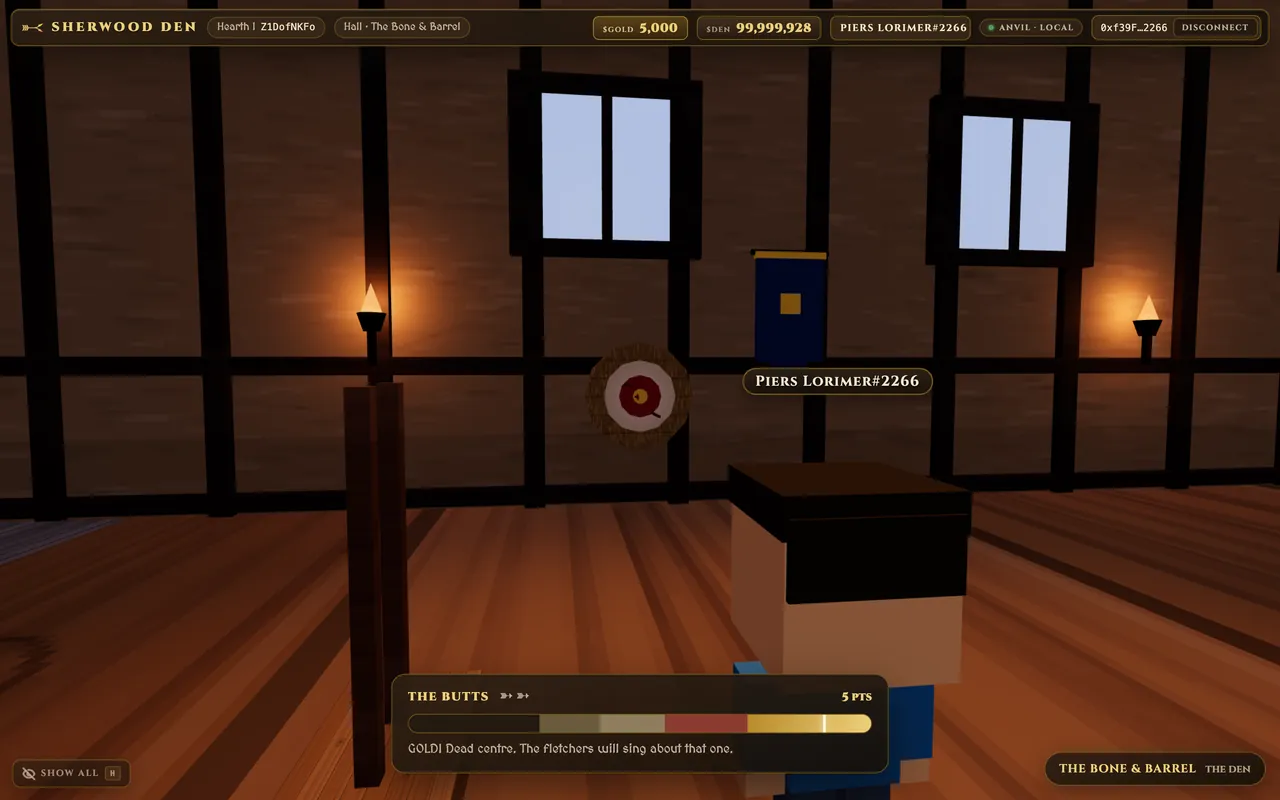
Wynn's butts, along the west wall, are the exception once you are through the door: they take no stake and they pay none. Aldith no longer runs a free throw; talk to her and she sends you to Cuthbert's board.
So the tavern wants both coins. $GOLD opens the door, $DEN plays the
board.
The other five halls have no warden, because they have nothing to charge for:
they are $GOLD paper trading and open when you reach them.
Your first time in
The first time you are inside the tavern, a short walk-through runs in the corner: speak to Cuthbert, read the board, then put a purse up. The control each step is about glows while that step is live, and the rules card on the wall stays as the manual, foldable and always there to reopen. The orientation out in the square stops at this door on purpose, because the pass costs more than an opening purse holds, so this is the run that covers the ring itself.
Nothing in here is a rehearsal. The moment you match a challenge or post one,
your $DEN is in escrow.
The board
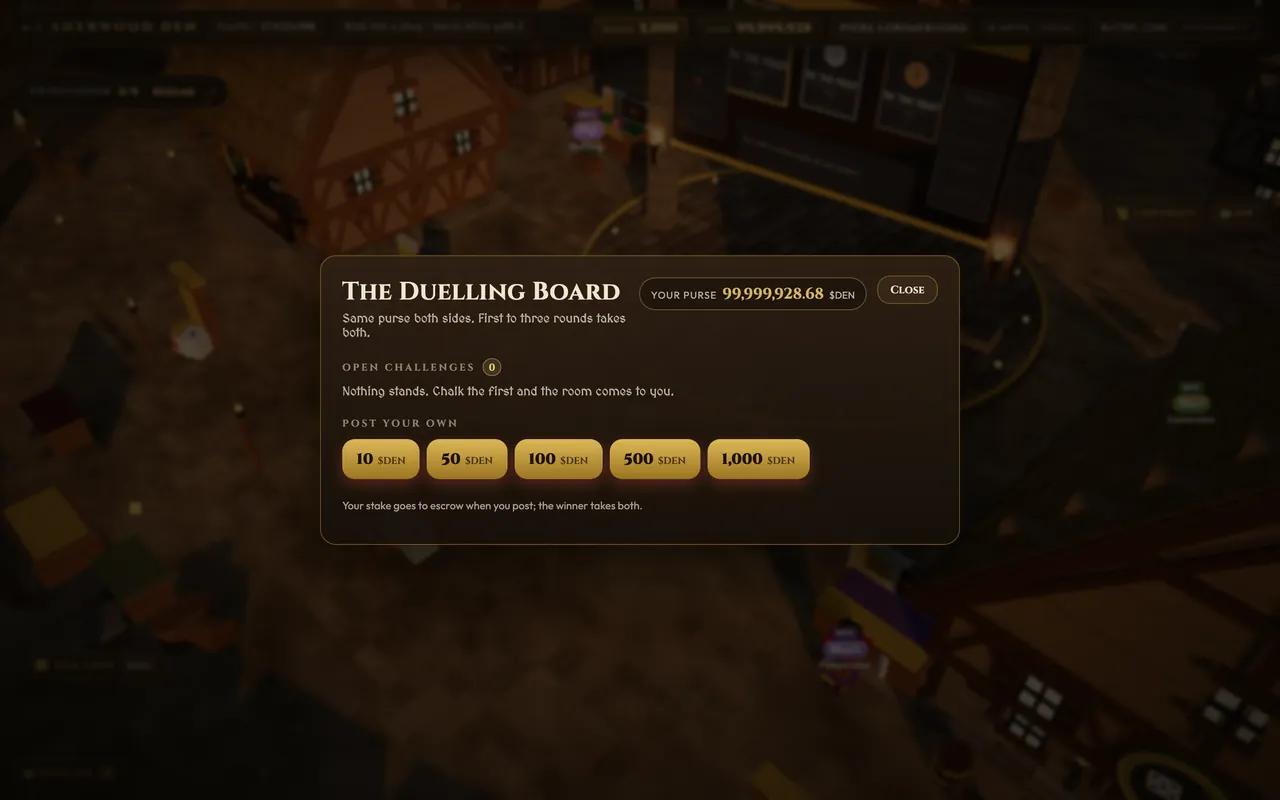
Talk to Ringmaster Cuthbert (or to Bones Aldith) and choose See the board. The board is one board for the whole den: when the tavern has split into several hearths (see the multiplayer page), every hearth reads the same list.
- Open challenges: who chalked them and for how much. Press Match it
to answer one; you need the same
$DENas the challenger. A busy hearth keeps one seat back for whoever comes to answer, so a full room is still answerable; if somebody takes that seat first the row says so and its Match is withheld. Nothing of yours moves until you are in the room: a refused crossing names the hearth and leaves your coin where it is. A challenge from another hearth wears that hearth's name and offers Cross & match instead: answering it moves you to their room first, since a duel is fought across one table. - At the tables: duels being fought right now at your hearth, with their stakes. A fight is only watchable from the room it happens in, so other hearths' live duels are not listed.
- Post your own: type a stake in
$DEN. There are no preset amounts; you name it, and if it falls outside what the ring accepts the panel says so with the floor or the ceiling before any wallet opens. One challenge per duellist; withdraw yours to change it.
The rules the board enforces, so nobody has to learn them by refusal: you cannot answer your own challenge, you cannot be in two duels at once, and a host must withdraw their challenge before answering somebody else's. Their stake is already escrowed under their own challenge and cannot move sideways. That last rule also blocks Cross & match while your own challenge stands: crossing hearths leaves your room, and leaving removes the challenge from the board without taking your stake. A plaza notice says “$DEN of yours is waiting, take it back.” Open the board, find Safe, and still yours, and press Recall to return that unanswered stake straight to the wallet.
Every duel needs the escrow deployed, a connected wallet, today's day pass paid,
and $DEN to match. Cuthbert names the price before any wallet prompt appears.
There is no wallet-less way to play in here.
How a duel plays
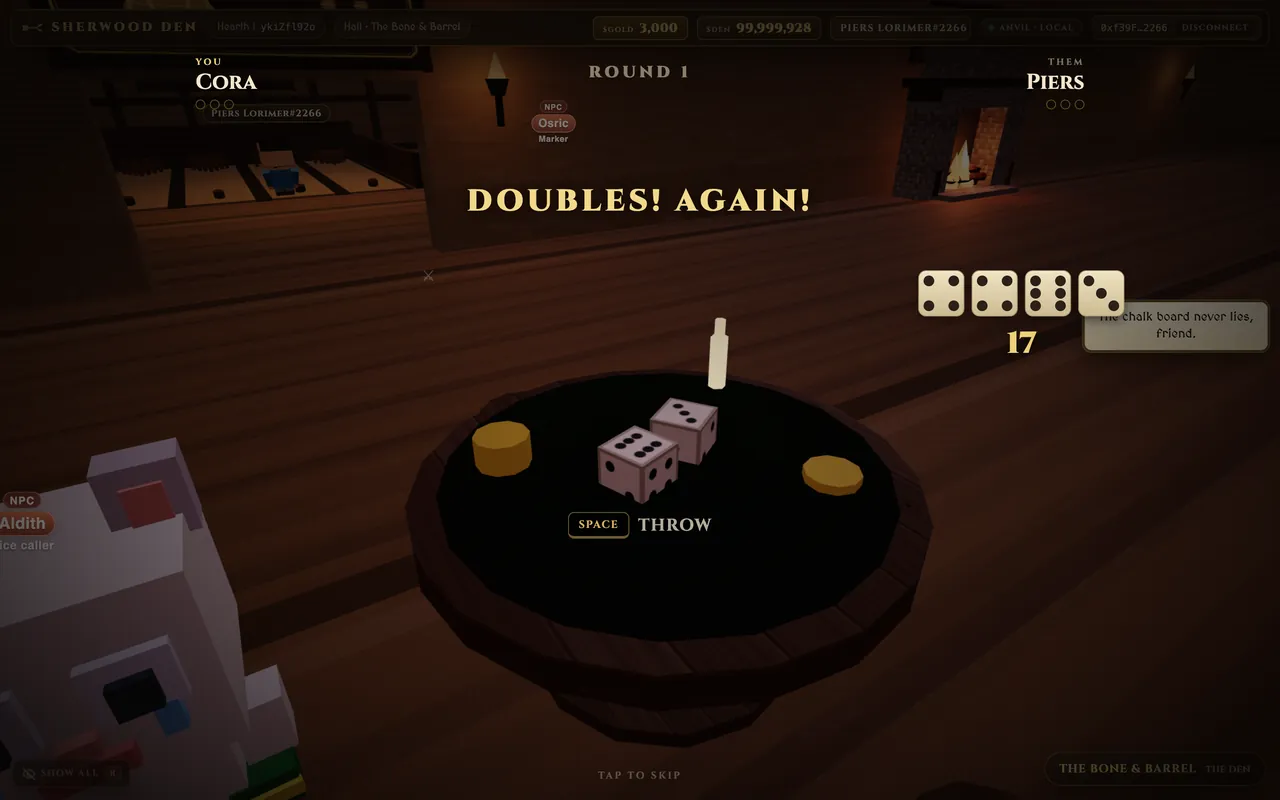
- The face-off: both names, the purse, and a stare-down. Any key skips it.
- Rounds. Each round both sides throw two dice; the higher total takes the round. Doubles throw again: matching dice add another throw to the hand, up to three throws in one hand.
- First to three round wins takes the pot, less the cut described under What the winner actually takes. A tied round scores nobody and the duel rolls on, so falling behind nought-two is a deficit, not a sentence.
You throw your own dice. The fight stops before every throw that is yours and after every round, and waits for Space: the prompt at the bottom of the card says which. The dice hang in the air for about a second before they land.
Sound carries the pacing, so it is worth having on.
There is a control on the card that skips ahead to the settlement, and a skip takes every remaining stop with it. Nobody is asked to press through nine more throws to see a result they have already decided to skip to. Do not tap the board itself expecting to skip: a tap there throws the dice, which is the opposite of what you wanted.
When the duel settles, the card lets go on its own after a few seconds and you stand up. You can also dismiss it yourself.
A settled duel is news. The den crier calls it across every room. A short
line at the top of the screen, "so-and-so took 500 $DEN off so-and-so",
visible wherever you are standing, gone a few seconds later. The strip over
the square turns through the standings rather than the duels; the full board
behind it keeps every settled duel, which is the history the crier does not.
What the winner actually takes
Both stakes sit in escrow, and the contract takes its cut from the losing side
before it pays out. 5% of the losing stake is sent to 0x…dEaD (an
address with no private key, so those tokens leave circulation for good) and
another 5% funds the den. The winner takes everything that is left.
Three things about that cut are fixed in the contract rather than promised:
- The burn and the den's fee together can never exceed 10%. The ceiling is enforced on chain, so no operator setting can raise the take past it.
- A duel records the rate at the moment it is opened and settles on that recorded rate. A change made while your stake is in escrow cannot reach it.
- The winner is never paid less than they staked. That floor holds by construction, not by choice of settings.
Nothing is taken from the winner's own stake. At today's rates, a duel of 100
against 100 $DEN pays the winner 190, burns 5, and sends 5 to the
den.
Only a decided duel is charged anything. A tie returns both stakes, and so do the escape hatches. Cancelling a challenge nobody accepted, the refund when a locked duel is never settled in time, and the return of a stake on a challenge that sat on the board unanswered. None of them burn a thing.
You do not have to take that on trust. The board prints the burn beside each settled duel, and the strip over the plaza square carries the running total of everything the den has burned by every route.
Why the result can be trusted
No one (not the house, not the other player) picks the dice:
- Before anything rolls, each side commits to a secret (its hash is published). Only when both commitments are in are the secrets revealed.
- Every round is derived from both secrets plus the duel id. Neither player could steer the rolls (each chose their secret before seeing the other's), and the server contributes no randomness at all.
- The full transcript (commitments, secrets, seed) is enough for anyone to recompute every round after the fact.
On a staked duel the money sits in the on-chain escrow the whole time; the server may only name the winner or call a tie, never pick a payee. If a duel dies mid-hand (someone disconnects, a reveal fails to verify), nobody wins and both stakes go back. A failed reveal is treated as a lie, not a lost packet, and produces no winner.
The return is not automatic, and it is worth knowing how it works. If the den never reports an outcome, the refund unlocks one hour after the duel was locked, and from then on anyone can trigger it, including you. It does not need the den's cooperation. An unanswered challenge you posted can be taken back sooner, and one that sat on the board unanswered for a day can be returned by anyone as well.
The butts
Talk to Fletcher Wynn and choose Take a shot. The line is three arrows and one input.
The needle sweeps the gauge at a constant speed. Loose with Space, click,
or tap when it is over the gold. A perfect press lands dead centre every time;
a sloppy one sprays. Scores are gold 5, red 3, ring 2, straw 1, wide 0. Wynn
calls each arrow and a verdict on the end. Another end starts the three
again; Leave the line or Esc walks you off.
The butts never take a wager. The score is judged on your machine, which is why they are not in the staked ring. They are still behind the day-pass door.