Skittles and the lanes
Through an arch on the north side of The Bone & Barrel is an annex with four skittles lanes in it. Two to four players put up the same entry fee and bowl five frames at the same time. With two players the highest score takes the whole prize; with three or four, the top two share it. A game takes about two and a half minutes.
This is the tavern's second staked game. Where a duel is one against one and turns on dice, the lanes are up to four at once and turn on your aim.
Getting to the lanes
The lanes are behind the same door as everything else in the tavern, so the
2,000 $GOLD day pass comes first. Warden Hob takes it at the entrance
and it holds until midnight UTC. There is no separate charge for the annex.
The arch that leads to it is marked with a keg rather than a word. The first
time you stand inside the tavern, Nori names the two people who run it so you
are not left guessing: Cuthbert at the duelling board, and Marker Osric
at the lanes. Osric is the one to find here. He keeps the frame, the throw
clock, and the scores.
Talk to Ringmaster Cuthbert and choose See the lanes. That opens the lobby, which is where a game is joined or started; you do not need to be standing in the annex to read it.
If you have not paid the door, the lobby says so (Pay the door before you call the lanes) and no fee can be put up until you have.
The lobby
The lobby shows the games that are open right now and lets you start one.
- Join an open game. Each row names the host, the entry fee, and how many of the four places are taken. Joining pays the fee to the contract there and then. It is an on-chain payment rather than a signature, so the fee leaves your wallet at that moment.
- Chalk a new game. Type your entry fee in
$DEN. There are no preset amounts; if yours falls outside what the lanes accept, the lobby says so with the floor or the ceiling before any wallet opens. Your fee opens the pot and everyone who joins pays the same one.
Whoever opened the game starts it. Nothing is bowled until the host calls the lanes, and the host cannot call them alone: two players must be standing at the lanes before the first keg goes down. Up to four can be.
You can walk out of a game you have joined while it is still open, and your fee comes back with you. Once the host calls the lanes, that door is shut.
How a game plays
Everyone bowls at once. There are no turns to wait through, so a four-player game takes exactly as long as a two-player one.
| Frames | 5 |
| Rolls per frame | 2, always |
| Time per roll | 15 seconds |
| Rolls in a game | 10 (about 2 minutes 30 seconds |
| Players | 2 to 4 |
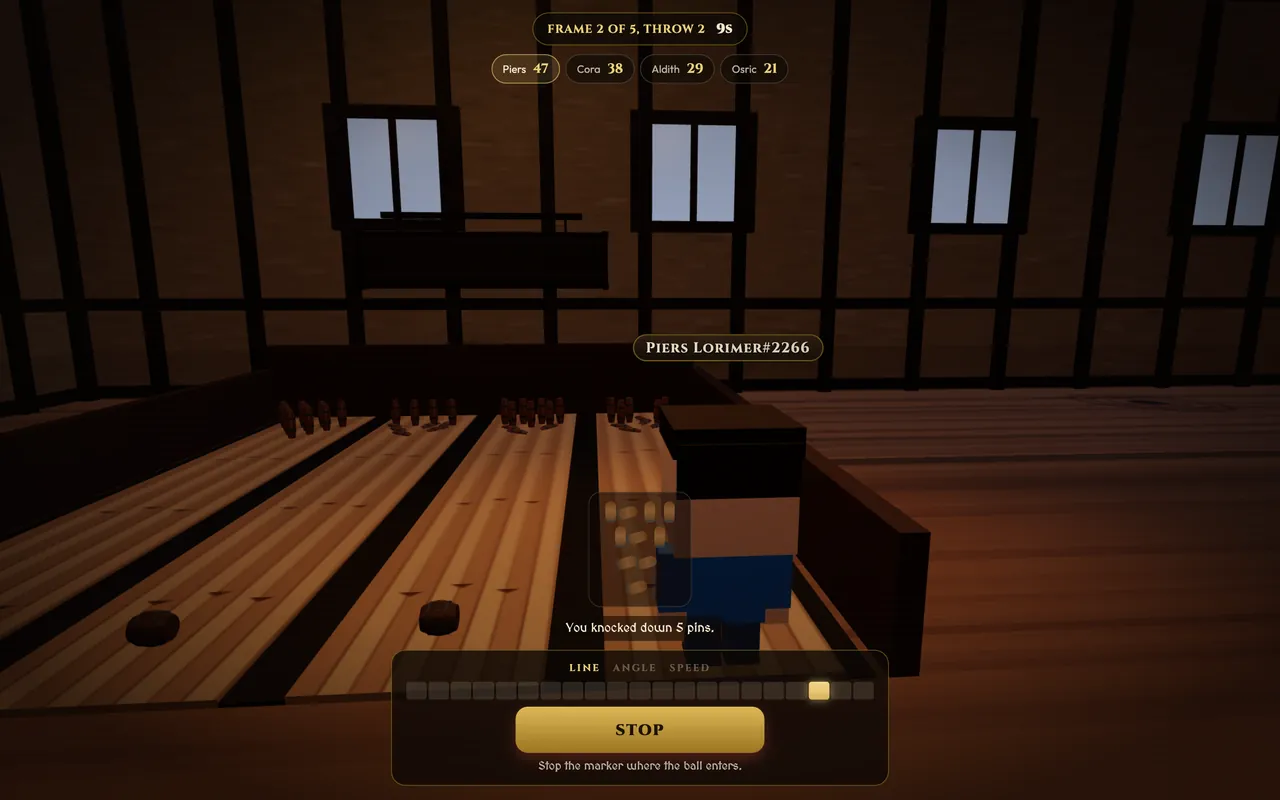
You roll a ball down a bed of four lanes at a rack of ten skittles) proper club-shaped pins, waisted and about knee height, set in the same triangle a ten-pin rack uses. The ball visibly runs the line you aimed: send it wide and it goes down the channel and fells nothing, which is the game telling you the truth about your aim rather than punishing you at random.
Aiming
The aim is a three-stage gauge, and each stage is one press. Space on a
keyboard, or the on-screen Stop button, which is what you use on a phone. A
marker sweeps a bar and you stop it:
- Line: stop the marker where the ball enters.
- Angle: stop the marker on your angle.
- Speed: stop the marker on your pace.
Speed is a carry profile rather than a measured velocity, and the middle of it is the one that scatters pins best; the slowest carries nothing at all and the fastest goes straight through. The difficulty is in the timing of three presses, not in picking a pocket on a continuous lane.
Let the 15 seconds run out and the server supplies a random aim so the other lanes are not held up. You remain in the frame, but you give up control of all three gauges for that throw.
Scoring
The score is simply the number of pins you knock down, and the most anyone can score is 100.
There is no strike bonus, no spare bonus and no bonus throw at the end. What happens instead is a rack reset: knock all ten with your first roll and the rack stands back up, and you throw your second roll at a fresh ten. That is what makes a first-roll ten better than a spare (ten and then seven is seventeen, where nine and then one is ten) without a bonus rule that would make some players throw more often than others.
If your first roll leaves pins standing, your second roll is thrown at what is left. Every frame starts on a full rack.
What the pot pays
Every entry fee goes into one pot. The contract removes the burn and team fee at the rates snapshotted when the game opened, then derives how many places can be paid without the lowest paid place receiving less than its own entry fee.
The burn is 5% of the pot today, sent to 0x…dEaD where it leaves
circulation permanently, and the den's fee is another 5%. As in a duel, the two
together are capped by the contract at 10%, and the rates a game settles on
are the ones recorded when it opened. A change made mid-frame cannot reach it.
- With two players, the winner takes the whole prize after those fees.
- With three or four players, the top two split the prize 62.5% / 37.5%.
- Third and fourth receive nothing.
The lobby reads the winner count from the contract for that game. Check the live number before joining rather than assuming it from the table size or from this guide. A settled prize is not pushed into the winner's wallet: the result card offers Claim, and the contract pays that winner once they press it.
Ties are broken by who joined first. The order is the one the contract itself holds, so it is a fact either player can check rather than a call the house makes.
Why the result can be trusted
- The pin judgement lives on the server and is a fixed table, not a physics simulation and not a roll of the dice. The same aim always fells the same pins.
- The lanes you watch are showing you a verdict that has already been made. The scene knocks down exactly the pins the result names, so the picture cannot disagree with the record.
- The record of aims is enough to recompute every score in the game.
- The money is held by the contract. The server may name the ranking; it never names an amount and never picks who gets paid.
When a game does not finish
Two different endings both return every entry fee, and the lobby tells them apart rather than lumping them together:
- The host never called the lanes. Nothing was bowled. Fees are waiting to be claimed.
- The lanes were locked but the score never reached the book. The game was played but the result never landed on chain. Nothing has moved, and the fees are waiting.
In both cases you claim your own fee back from the lobby. A game that is never started stays open for 24 hours, and a game whose result never lands becomes refundable an hour after it locks.
Prizes and refunds remain individually claimable for at least the contract-configured claim window shown by the deployment. After that window, the contract owner can sweep anything nobody collected, so do not leave a settled prize or returned fee waiting indefinitely.
What is confirmed today
The lanes have been verified in a local test environment against a locally deployed escrow. No public deployment is confirmed to have them. Treat this page as describing what the game does, not as a promise that you can go and play it right now, and check the network shown on screen before signing anything.
Nothing here promises profit. An entry fee is at risk the moment the host calls the lanes.